
Despite recent advances in electric engine technology, petrol engines remain the most common form of vehicle propulsion today. In 2017, for example, 76% of the world’s vehicles used gasoline to power their engines. That’s ¾ of the whole car market. In North America alone, that number is even higher, not even accounting for hybrid vehicles. All of these engines share one common thing – spark plugs. Without them, no gasoline engine can even start, let alone work. And even if you have only one bad spark plug, several problems will arise.
Spark plugs ignite the fuel in the combustion chamber, which then transfers into motion. When driving, your car’s spark plugs work tirelessly to ignite the fuel several thousand times per minute. Typically, after many hours of work, they will wear out and stop igniting the fuel. Your vehicle might not stop working immediately, but unwanted symptoms will start to appear.
In this article, we will review all the manifestations of a defective spark plug. We recommend reading through all of them carefully, as driving with faulty spark plugs can quickly damage other components and systems.

How Many Spark Plugs are There in Your Car?
It depends on the number of cylinders in your engine. Most engines have one spark plug per cylinder, but some models have two. Still, on most cars, the number of cylinders equals the number of spark plugs. When a spark plug starts misfiring, one of the cylinders will stop working. The computer will still supply the cylinder with an air-fuel mixture, but the spark plug won’t ignite it.
Can Bad Spark Plugs Make Your Car Run Poorly?
Yes, they can, and they will. When one of the cylinders in your engine doesn’t work, you will immediately feel a difference. The motor will be less balanced than before, wasting fuel and losing power. The reason is pretty simple – other cylinders must work extra hard to make up for the misfiring cylinder. This will be especially noticeable in powertrains with fewer cylinders, such as three- and four-cylinder engines.

What are the Symptoms of a Faulty Spark Plug?
A faulty spark plug can cause a range of symptoms. Some of them can also connect to other faulty parts. However, when the following symptoms arise, they are most often related to a defective spark plug. In other words, we recommend checking the plugs first and, if they’re okay, checking other related parts.
Just so you know, some symptoms are immediately recognizable, while others may appear over time. We strongly recommend that you check for ignition system-related problems as soon as possible. Otherwise, it might be too late, and other parts of your car might be damaged.
Here is how to tell if a spark plug is misfiring.
Rough idle
Modern car engines run very smoothly at idle, with almost no vibration. However, when a plug is faulty, the engine will immediately run rougher. You will feel more vibrations, and the car will begin to shake.
Then there’s the issue of bad spark plug sound. The engine will start operating irregularly, which will translate into a rough, uneven tone. These things won’t change even if you press on the gas pedal. The motor will still sound rough, and vibrations will be felt through the dashboard.
Other faulty parts, such as the spark plug cables and coil-on-plug units, might cause a rough idle. Nonetheless, this symptom is mainly associated with bad spark plugs.

The engine has trouble starting.
While most engines can start with one bad spark plug, they still have a hard time doing so, especially in winter. Unlike a dead battery, the engine will run only for a second or two before shutting off. It will literally sound like the engine coughs up.
So, how do you start a car with bad spark plugs and drive it to the nearest mechanic? You should press the gas pedal slightly only when the engine starts firing the cylinders.
Slow acceleration
Without one of the spark plugs, the motor will produce much less power than before. Most of the energy is lost in the misfiring cylinder, which doesn’t function at all. Moreover, other cylinders must put in extra work to offset the losses in the misfiring cylinder, such as compression and friction losses.
The result is a significant loss of power. The acceleration will be much slower, especially on inclines. You should use higher revs (revolutions per minute) to keep up with traffic.
Increased fuel consumption
Despite the faulty spark plug, the fuel delivery system will still supply the engine with the same amount of fuel. At the same time, you will ask more from the engine because it won’t have enough power. The result? Poor fuel economy and black smoke from the exhaust.
You might not notice the reduced fuel efficiency, especially if your tank is full. That’s why we recommend checking the car’s information data regularly. If you see a significant increase in fuel consumption, it might be due to a faulty spark plug.
Check engine light
Modern gasoline engines have sensors that alert the driver when a cylinder is misfiring. On most recent vehicles, the check engine light on your dashboard should illuminate as soon as a few consecutive misfires are detected. Once the check engine light is on, a code should have been recorded in the car’s PCM. You’ll need an OBDII code reader to read the code and diagnose the problem.
Problems with the catalytic converter
The catalytic converter reduces emissions from gasoline cars. However, it is also susceptible to fuel deposits and might get easily damaged by anything other than engine fumes.
When one of the cylinders is misfiring, it sends the air-fuel mixture directly to the catalytic converter. Then, the unburnt gasoline might damage the converter, especially if you drive your vehicle for a prolonged time. Even worse, replacing the catalytic converter is quite expensive – be sure to sort any misfiring cylinder problem asap.
What do Bad Spark Plugs Look Like?
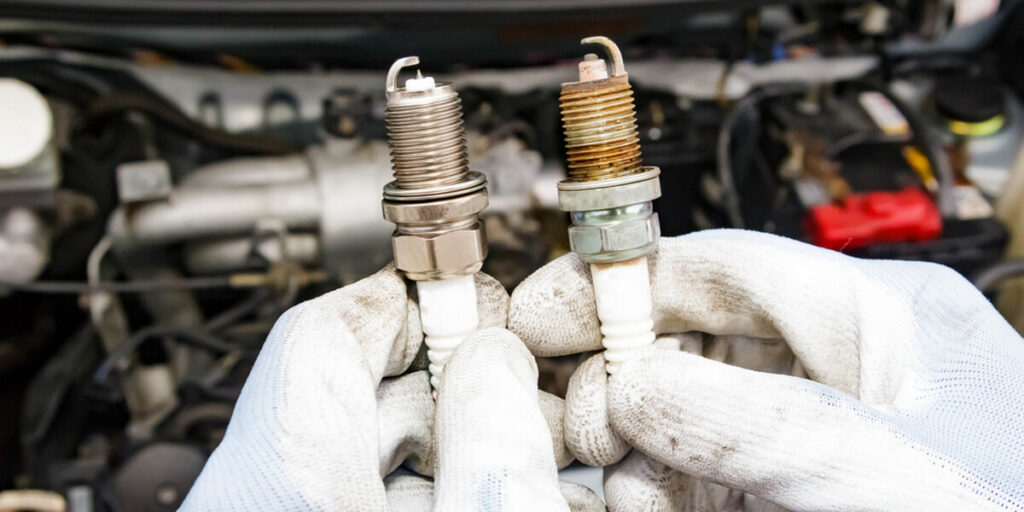
Luckily, there is a way to tell if you have a faulty spark plug only by looking at it. First of all, though, you need to know what spark plugs look like. When healthy, the insulator tip and electrode (top of the plug) will be grayish-white or grayish-yellow. This means that the cylinder burns its air-fuel mixture efficiently.
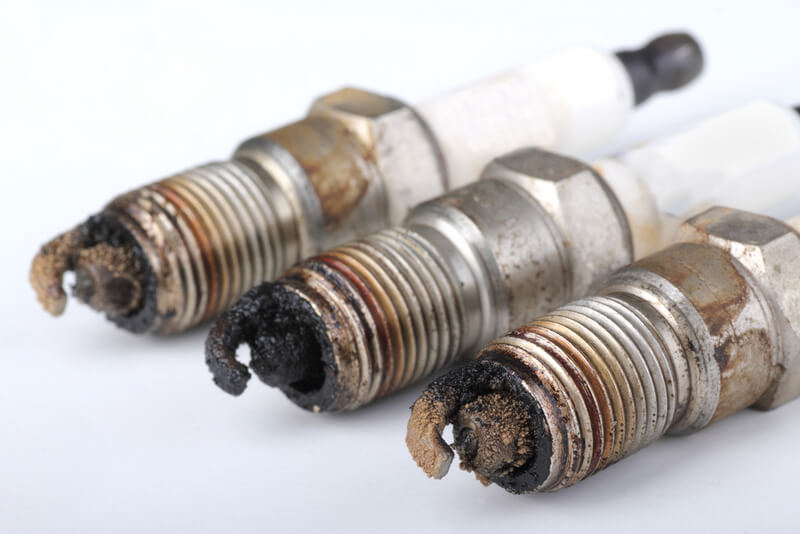
Depending on the reason for the faulty plug, look for these colors and deposits:
- Wet spark plugs are the result of flooding inside the combustion chamber. This usually happens when you try to start the vehicle and introduce a lot of fuel, yet it still won’t start. In this case, use brake cleaner to remove fuel deposits.
- Black carbon deposits on the top and electrode are the most common sign of defective spark plugs. They usually occur when the air-fuel mixture is incorrect, due to faulty sensors or damaged spark plugs. This can also happen on older engines that already have carbon deposits inside the combustion chamber. You can remove deposits with sandpaper, but it will only slightly extend the plug’s lifespan.

- Oil deposits on the tip or electrode might be a result of an engine that needs rebuilding. Usually, when the piston rings, the pistons or the valve cover gasket is worn out, and engine oil may enter the combustion chamber. Then the engine oil sticks to the spark plug, completely disabling it.
- Yellow or brown deposits on the tip and electrode point to low-quality gasoline or additives.
- White deposits indicate that the engine is burning coolant. In such a case, the head gasket might need to be replaced.
Whatever the issue, we recommend installing new spark plugs regularly. Also, could you please address any prior problems with the engine? Otherwise, the new spark plugs might wear out quickly.